Prompt Design · Chapter 2 · Lesson 1 · 6 min read
Writing clear instructions
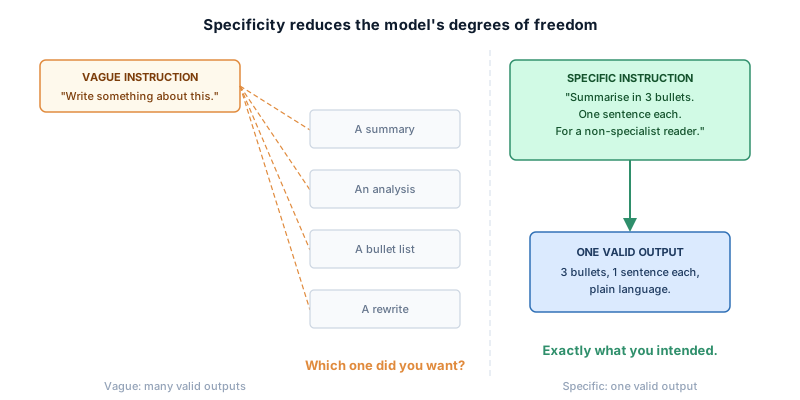
A language model always produces an output. The question is whether it matches what you wanted. When it does not, the instinct is to blame the model, but the prompt usually reveals the cause: the instruction allowed several plausible interpretations, and the model chose one you did not intend. It left too much open.
An instruction is clear when only one reasonable output satisfies it.
The three things every instruction must specify
A complete instruction answers three questions. Leaving any one unanswered is where most instructions break down.
The first is what action to take. Summarise, classify, translate, compare, rewrite, extract, list: the verb determines the structure of the output. Omit it and the model guesses, differently on different runs.
The second is what the scope is. Which part of the context does the instruction apply to? All of it, a specific section, a particular field? When a prompt contains multiple pieces of content and the instruction does not say which, the model picks one on its own.
The third is who the audience is. A technical expert, a student, a non-specialist. The audience determines vocabulary, assumed knowledge, and level of detail. The model cannot infer it from the task alone, so if your audience differs from a generic adult reader, say so.
Specificity is not length
It is easy to confuse a long instruction with a clear one. Consider two instructions for the same task:
Vague:    Write something about this article.

Specific: Summarise this article in three bullet points.
          Each bullet must be one sentence. Write for a reader
          with no background in machine learning.
The vague version is short. The specific version is longer, but not padded: every additional word closes off a degree of freedom the model would otherwise have. Word count is not the measure of a good instruction; degrees of freedom are.
Name the action verb explicitly
The action verb is the most load-bearing word in an instruction. Different verbs produce structurally different outputs from identical input:
- Summarise: condenses the source, preserves key points, discards detail
- Analyse: identifies patterns, causes, or implications not explicit in the source
- List: enumerates items in a flat structure, no prose
- Compare: produces a structured contrast between two or more things
- Rewrite: transforms the source while preserving its meaning
The wrong verb produces output that is technically responsive but structurally wrong. No verb produces output that is arbitrary. Neither is what you want.
Scope: be explicit about what the instruction applies to
When a prompt contains multiple pieces of content, an instruction without a scope reference is ambiguous, even if it does not feel that way:
Ambiguous: Here is a research paper and a blog post.
           Summarise the main argument.

Explicit:  Here is a research paper and a blog post.
           Summarise the main argument of the research paper only.
           Do not refer to the blog post.
The error from ambiguous scope is easy to miss, because the output looks correct. The model followed the instruction; it just applied it to the wrong content.
Audience: state it, do not imply it
The model’s default audience is a generic, moderately informed adult. If yours is different, state it directly. “Explain this” produces a different output for an expert than for a beginner, and the model cannot infer which you mean from the task alone.
Without audience: Explain how gradient descent works.

With audience:    Explain how gradient descent works to a software
                  engineer who has never studied machine learning.
                  Do not use matrix notation.
The audience also drives specific constraints. “Do not use matrix notation” follows from the stated knowledge level; spelling it out makes the constraint explicit, so the model cannot treat the audience as approximate.
A checklist before you send
Before sending an instruction, check three things:
- Is the action verb present and unambiguous?
- Is the scope explicit if the prompt contains more than one piece of content?
- Is the audience stated if it differs from a generic adult reader?
If any answer is no, the instruction has a gap. The model will fill it plausibly, which makes the error easy to miss.
In the next lesson, we’ll look at how the phrasing of a constraint, whether you state what to do or what not to do, affects how reliably the model follows it.